
Our recent phase 1 trial exploring the combination of Nivolumab and metronomic chemotherapy entitled: METRO-PD1: Phase 1 study of nivolumab in combination with metronomic chemotherapy in children and adolescents with relapsing/refractory solid tumors has just been published in the European Journal of Cancer by Nicolas André, Marie Cécile Le Deley, Clémence Léguillette, Alicia Probst, Leen Willems, Romain Travers, Isabelle Aerts, Cécile Faure-Conter, Gabriel Revond-Riviere, Victoria Min, Birgit Geoerger, Pascal Chastagner, Natascha Entz-Werlé, Pierre Leblond from:
– Marseille-La Timone University Hospital, Oncologie pédiatrique, CRCM INSERM U1068 SMARTc Aix Marseille University & Metronomics Global Health Initiative, Marseille, France
– Oscar Lambret Comprehensive Cancer Center, Department of Clinical Research, Lille, France
– Department pediatric hematology and oncology, UZ Ghent, Belgium
– Centre François Baclesse, Centre de Traitement des Données du Cancéropôle Nord-Ouest, Caen, France
– Institut Curie, PSL Research University- Oncology Center SIREDO, Paris, France
– Centre Léon Bérard, IHOPe, Lyon, France
– Gustave Roussy Cancer Campus, Department of Pediatric and Adolescent Oncology, INSERM U1015, Université Paris-Saclay, Villejuif, France
– Nancy University Hospital, Service d’hémato-oncologie pédiatrique, Nancy, France
– Strasbourg University Hospital, Pédiatrie Onco-Hématologie - Pédiatrie III, Strasbourg, France
– Oscar Lambret Comprehensive Cancer Center, Pediatric Oncology Unit, Lille, France
A randomized phase 2 trial evaluating metronomic vs metronomic + nivolumab is ongoing.
ABSTRACT
BackgroundThis multicenter Phase I study (NCT03585465) evaluated nivolumab in combination with 3 metronomic chemotherapy (MC) regimens in children with refractory/relapsing solid tumors. Objectives: To evaluate the feasibility and safety of the three regimens
MethodsPatients aged <18>
2 cycles and > 70% of the planned dose.
PopulationSixteen patients were enrolled, 3 in arm A, 6 in arm B, and 7 in arm C. Median age was 11.5 years (range, 5-19). Patients previously received a median of 3.5 (range, 1-4) lines of systemic treatment, 14 patients had surgery and 11 had radiotherapy.
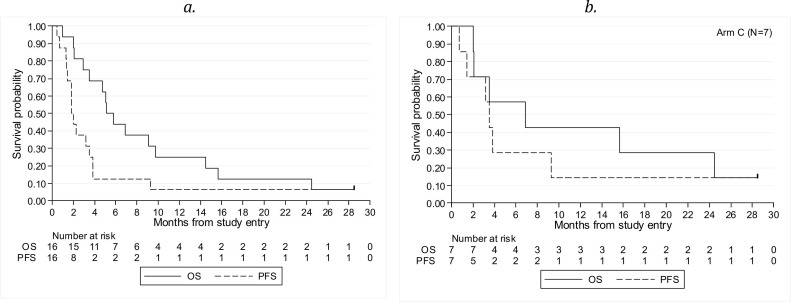
ResultsMedian number of cycles was 2 (1-24), median treatment duration was 56 days (18-714). In arm C, median number of cycles was 4 with median treatment duration of 95 days. No DLT was observed. Grade 3 adverse events (AE) and serious AE were observed in 8 patients (50%) and 1 patient (6%), respectively, over the first 2 cycles. No grade 4 AE occurred. The 6-month PFS and OS were 12% and 44%, respectively, in the whole population. Prolonged stable disease was observed in a high-grade glioma and an atypical teratoid rhabdoid tumor.
ConclusionArm C appears safe. A randomized phase II trial evaluating the addition of nivolumab to the triple MC is ongoing.
the full text is freely available here


Comment on this article
discussion